

Quick answer: Start by deciding whether you need alterations on a suit you already own, or a new bespoke suit built from scratch. Find a tailor who does all work in-house, book a consultation, and plan on at least one fitting before final delivery. In Atlanta, simple alterations can be done in as little as two hours. A full custom suit takes seven days.
You already know what a well-fitted suit does. You’ve seen it on someone else and felt the difference the moment you walked into the room wearing one yourself. But knowing you need tailoring and knowing how to get it done right are two different things. This guide walks you through the full process, from figuring out what you actually need to finding the right person to do it.
Why Fit Is the Only Thing That Matters
An expensive suit that doesn’t fit looks cheaper than a modest one that does. The fabric, the label, the price tag—none of it matters if the jacket pulls across your shoulders or the trousers bunch at the knee. Fit is the foundation.
Off-the-rack suits are built for an average body that doesn’t actually exist. They’re cut to move volume, not to move with you. Even a good department store suit will have something off: the sleeve hits too low, the chest gaps, the waist floats. That’s not a flaw in you. It’s a limitation of the system.
Getting your suit tailored closes that gap. It doesn’t matter whether you’re starting from scratch with an Atlanta custom suit or bringing in something you already own. The right tailor takes what’s there and makes it work for your body, your posture, and the way you carry yourself.
Does a tailored suit actually make a visible difference?
Every time. Dalvin R. Lane, a long-time ATL Tailor client, put it plainly: every time he wears a suit tailored by ATL Tailor, strangers stop him to ask who made it. That’s not about the fabric or the brand. It’s entirely about fit.
Know What You Need Before You Walk In
Before you book anything, get clear on which situation you’re in. There are two paths, and they lead to different conversations.
- Path one: you already have a suit. It fits reasonably well but needs refinement. Maybe the sleeves are a half-inch too long, or the waist bags out when you button it. This is an alterations job. A skilled tailor can reshape the jacket, hem the trousers, and bring the whole thing into proportion without starting over.
- Path two: you need a suit built for you. Nothing off the rack has worked, you have an important event coming up, or you want something that genuinely reflects your style. This is where bespoke comes in. Your tailor starts from scratch, patterns the suit around your measurements, and you end up with something that no one else is wearing because it was made specifically for you.
Knowing which path you’re on helps your tailor give you accurate pricing and a realistic timeline from the first conversation. It also saves you from showing up expecting alterations when what you actually need is a new build, or vice versa.
How to Find the Right Tailor in Atlanta
If you’ve searched for alterations near me or where can I get a suit altered in Atlanta, you’ve seen the options range from dry cleaners with a sewing machine in the back to dedicated tailoring houses with decades of experience. Those are not the same thing.
Here’s what separates a tailor worth trusting from one who will disappoint you:
- They do the work in-house. Any tailor worth recommending handles every stitch on-site. The moment your garment leaves the shop and goes to an outside contractor, you lose quality control. Ask directly: is this done here or sent out?
- They take time to understand the garment. A skilled tailor doesn’t just measure you. They look at how the suit is constructed, where the seam allowance lives, and what’s structurally possible. Shoulder alterations on a $300 suit, for example, are rarely worth the cost. A good tailor tells you that upfront.
- Their clientele speaks for itself. Atlanta tailors who dress executives, musicians, public figures, and film production teams have proven they can handle precision work under pressure. That track record matters more than a slick website.
- They’re transparent about timelines. Good tailors give you a clear window and stick to it. Vague answers about when your suit will be ready are usually a sign of disorganization, outsourcing, or both.
ATL Tailor in Buckhead handles all work in-house under the direct supervision of Hong, a master tailor with nearly 50 years of experience rooted in Vietnamese tailoring tradition. No outsourcing, no middlemen, no dropped details. That’s the standard Atlanta tailor clothes deserve.
“ATL Tailor is the absolute best custom Tailor in the City of Atlanta. I have been a customer for over two decades and their work is flawless and professional.”
— Thurbert Baker, Former Attorney General of Georgia
What should I look for when choosing between Atlanta tailors?
In-house work and verifiable experience are the two non-negotiables. Everything else, price, location, hours, is secondary. A tailor who outsources to a third party cannot guarantee the consistency or timeline they quote you. A tailor whose clients include public figures, film productions, and executives has demonstrated the ability to perform under real pressure with real stakes.
What Happens During a Suit Fitting
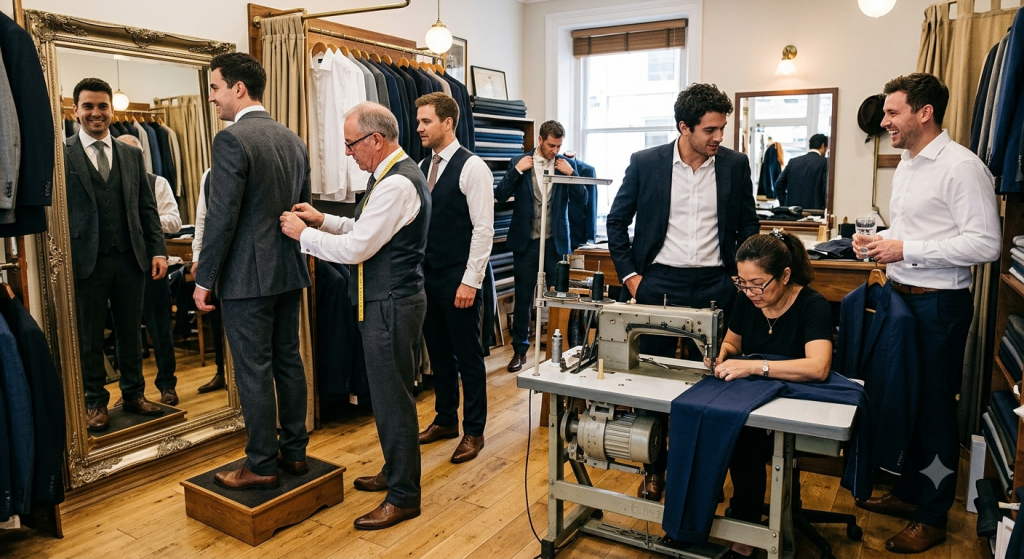
A proper fitting isn’t just someone with a tape measure. It’s a conversation. Here’s how it typically unfolds at a tailoring house that takes the work seriously.
- Consultation. Before anything gets measured, a good tailor asks about the occasion, your lifestyle, and what you want the suit to do for you. A courtroom suit and a wedding suit are both suits. They’re not the same suit.
- Measurements. This goes beyond chest and inseam. A thorough tailor notes your posture, your shoulder slope, how you stand, and how you move. These details are what separate a suit that fits perfectly when you’re standing still from one that stays sharp when you sit down, reach across a table, or step out of a car.
- Fabric or alteration scope. If you’re building a custom suit, this is when you choose your fabric, lining, lapel style, and details. If you’re altering an existing garment, this is when the tailor marks what needs to change and walks you through what’s achievable.
- Fittings. For a bespoke build, you’ll typically come back at least once for a fitting on the partially constructed suit before it’s finished. This is where the real refinement happens, and where a tailor’s experience shows.
- Final delivery. You pick up your suit, try it on, and confirm everything is right. A tailor confident in their work will make any final adjustments on the spot or within 24 hours if needed.
What this looks like in practice: a client walks in with a department store suit and a meeting in two days. During the consultation, Hong identifies a collar gap caused by forward shoulder posture, a chest that pulls slightly left, and trousers that break too low. She knows immediately which adjustments hold and which would compromise the jacket’s internal structure. That kind of read comes from nearly 50 years of handling fabric, not from a checklist. The suit goes back out looking like it was made for him, because in every way that matters, it now is.
How many fittings do you need for a custom suit?
For a full bespoke suit, plan on two fittings minimum: one on the partially constructed garment to check balance and drape, and one final try-on at delivery. Highly experienced tailors sometimes reduce this without losing accuracy. For alterations on an existing suit, one fitting is typically enough, with any final tweaks handled at pickup.
Common Suit Alterations and What They Typically Cost
If you’re working with an existing suit, here are the most common adjustments and what you can expect to pay. Pricing varies by shop and complexity, but these ranges give you a starting point.
- Trouser hem. The most frequent alteration. Shortening or letting out the trouser length, with or without cuffs. Starting around $20 at ATL Tailor.
- Waist suppression on the jacket. Bringing in the sides of the jacket for a cleaner silhouette. Typically runs $40 to $80 depending on how much material needs to move.
- Sleeve length. Shortening or lengthening jacket sleeves, with attention to how the buttonholes are finished. If the sleeve has working buttonholes, the adjustment gets made from the shoulder rather than the cuff, which is more involved. This is detail work that reveals a tailor’s skill quickly.
- Taking in or letting out the seat and thighs. Common for trousers that fit well at the waist but pull or bag through the seat. More complex than a hem but absolutely worth it.
- Collar gap correction. When the jacket collar lifts away from your shirt collar at the back. This is a posture-related fit issue that many tailors skip. The right tailor addresses it.
- Shoulder restructuring. The most significant alteration possible on a jacket, and the one with the most caveats. If the shoulders don’t fit, it’s worth having a conversation about whether altering or replacing makes more sense. A tailor with real experience will give you an honest answer.
How Fast Can You Get a Suit Tailored in Atlanta?
Speed depends on what you need done. The good news: you have more options in Atlanta than most people realize.
For alterations on an existing suit, ATL Tailor handles simple fixes in as little as two hours. Hem your trousers on a lunch break. Pick them up before the evening event. For more involved work, plan on two to five days, still well within most professional timelines.
For a full Atlanta custom suit built from scratch, ATL Tailor delivers in seven days at $899. That includes the consultation, measurements, fabric selection, construction, and any final adjustments. It’s a timeline that genuinely works for busy schedules, not just clients who can plan two months out.
If you’ve been searching for where can I get a suit altered in Atlanta with a tight deadline, ATL Tailor’s rush service exists precisely for that situation. The work doesn’t slow down because the timeline is short. Everything still happens in-house, under the same supervision, with the same standards.
“I had never shot in Atlanta before and can honestly say that I don’t know how I would have accomplished this without the help of ATL Tailor. Their work is impeccable. They are able to work under a tight deadline.”
— Susan Matheson, Costume Designer, Anchorman 2, Los Angeles, CA
Can I get a suit altered the same day in Atlanta?
Yes, for simpler adjustments. ATL Tailor in Buckhead offers rush alterations as fast as two hours on hemming, tapering, and similar work. More complex jobs like waist restructuring or recuts typically take two to five days. Call ahead if your timeline is tight, and they’ll tell you exactly what’s achievable.
Mobile Tailoring: When the Tailor Comes to You
Not every client can make it to Buckhead during business hours. Some schedules don’t bend that way. ATL Tailor’s mobile fitting service is designed for exactly that.
Hong and her team come to your home, your office, or wherever you need them. They take measurements on-site, discuss your needs directly, and bring fabric options if you’re building something new. Your finished garment gets delivered to you when it’s ready. You don’t fight traffic. You don’t rearrange your calendar. You just show up dressed well.
For Atlanta executives, attorneys, and professionals whose time is genuinely scarce, this isn’t a luxury add-on. It’s a practical choice that removes every friction point from the tailoring process.
Ready to get it done right? Visit ATL Tailor in Buckhead, or book a mobile fitting and let us come to you. Walk-ins are welcome, and rush appointments are always available.