Filed under Tailoring Corner
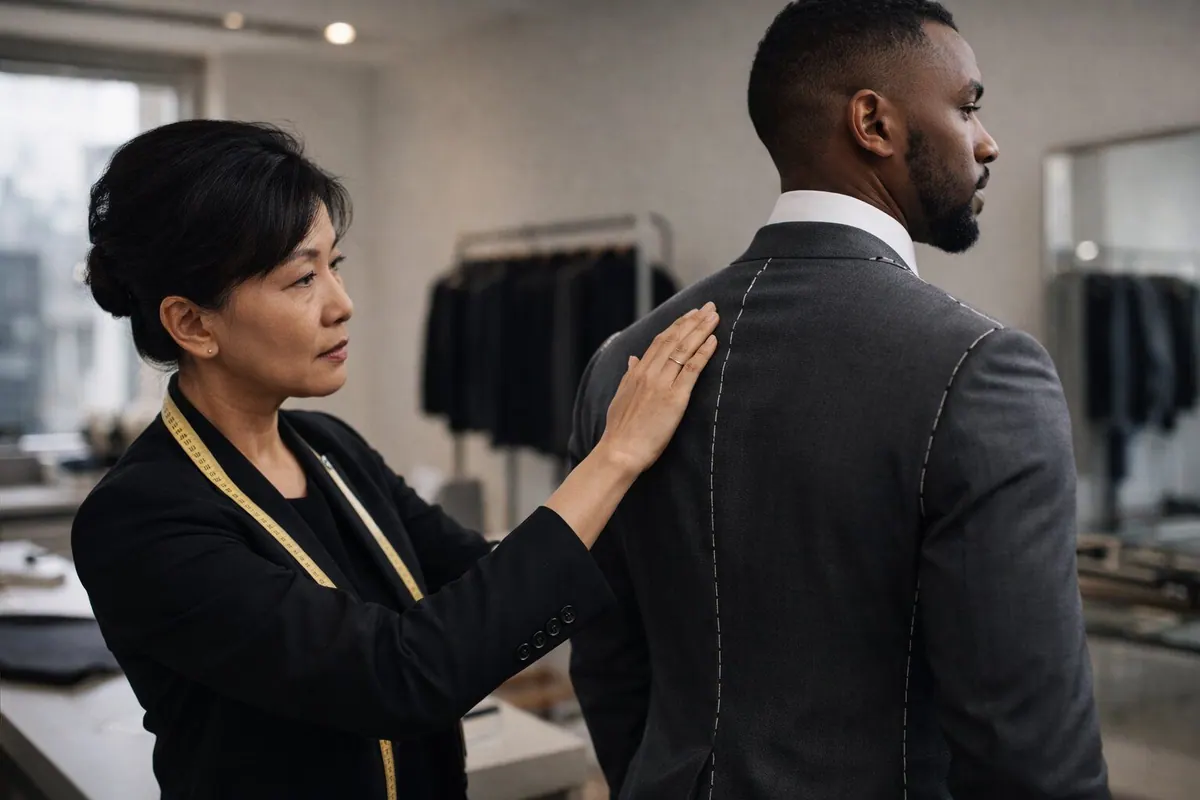
Most people assume a well-fitted suit starts and ends with measurements. Chest, waist, sleeve length, and inseam. Those numbers matter, but they are only the surface. The real difference between a suit that simply fits and one that feels effortless comes from something far less obvious.
An experienced tailor reads body language.
Before fabric is cut, before patterns are finalized, a skilled tailor studies how a client stands, walks, shifts weight, and holds tension. These observations guide decisions that no measuring tape can capture. This is why bespoke tailoring feels fundamentally different—and why some suits never feel right, no matter how many alterations they go through.
Understanding how a tailor reads your body language reveals what true craftsmanship actually looks like.
Why Measurements Alone Are Not Enough
Measurements describe size. They do not describe behavior.
Two individuals with identical measurements can require completely different suits. Bodies are dynamic. They lean, rotate, compensate, and adjust subconsciously throughout the day. One shoulder sits lower. One hip carries more weight. The spine curves forward slightly from years at a desk.
When tailoring ignores these realities, problems appear immediately:
- Jackets pull when walking
- Collars gap or press into the neck
- Sleeves twist out of alignment
- Balance collapses the moment the wearer moves
True bespoke tailoring begins where measuring ends. It starts with observation.
What a Tailor Observes Before You Move
The reading of body language begins the moment a client stands still.
An experienced tailor looks for:
- Natural head position
- Shoulder height and slope
- Spinal alignment
- Weight distribution between feet
These details determine how a jacket must be shaped. A forward head posture affects collar construction. Uneven shoulders influence sleeve pitch and jacket balance. A dominant leg changes how trousers hang.
None of these are flaws. They are normal human characteristics. A good tailor adapts the garment to the body, not the body to the garment.
How Movement Reveals the Real Fit Requirements
Standing still only tells part of the story. Movement reveals the rest.
A tailor watches how a client:
- Walks across the room
- Sits and stands
- Reaches forward or turns
These actions expose tension points that mirrors never show. Movement reveals where fabric must release, where structure must support, and where balance must be adjusted.
This is why a suit can look acceptable in front of a mirror yet feel restrictive in daily life. Mirrors show stillness. Tailors design for motion.
Shoulder Behavior and Arm Movement
Shoulders communicate more than most clients realize.
Some shoulders roll forward. Others sit back. Some rotate freely, while others remain tight and restricted. These patterns dictate how sleeves must be set and how the jacket must be structured.
If sleeve pitch does not align with natural arm position, the jacket twists every time the arms move. This causes discomfort, visual distortion, and constant adjustment.
A skilled tailor identifies this behavior immediately and adjusts the cut before the garment is finalized. When done correctly, the suit feels natural instead of resistant.
Balance and Drape Are Read Through Body Language
Balance refers to how a garment hangs evenly around the body. When balance is correct, the suit feels supportive and composed. When it is wrong, discomfort is constant, even if subtle.
Body language informs balance decisions such as:
- Adding length to the front for a forward-leaning posture
- Compensating structure on a dominant side
- Shaping the collar for upper-back tension
These adjustments are invisible when executed properly. That invisibility is the mark of mastery.
Why Alterations Cannot Replace This Process
Alterations modify an existing garment. They do not reinterpret its foundation.
Most alteration work is reactive:
- Shorten here
- Take in there
- Adjust what is already wrong
Bespoke tailoring is proactive. Structural decisions are made before the garment exists. Body language is accounted for at the cutting stage, not patched later.
This is why repeatedly altered suits often feel “almost right” but never effortless. The garment was never designed for the wearer’s movement in the first place.
What Expertise Looks Like in Practice
Reading body language is not a checklist. It is a skill developed through years of experience observing how fabric behaves on real bodies.
At ATL Tailor, bespoke work is overseen by a master tailor trained from childhood in traditional Vietnamese tailoring techniques. That tradition prioritizes observation, intuition, and adaptation over formulas.
Posture, movement, and balance are evaluated before cutting begins. This is why the finished garment feels intuitive rather than restrictive.
What This Means for the Wearer
When a suit is designed around body language:
- The jacket moves naturally with the body
- Posture feels supported, not forced
- Confidence becomes effortless rather than performative
The wearer stops thinking about the suit entirely. That is the goal of true tailoring.
How to Recognize a Tailor Who Understands Body Language
Clear indicators of expertise include:
- Observing you before measuring
- Asking you to walk, sit, or move
- Discussing balance rather than just size
- Explaining why adjustments are being made
If a fitting begins and ends with a tape measure, critical information is being missed.
Fit Is Interpreted, Not Calculated
A great suit is not built from numbers alone. It is built from understanding how a person occupies space.
Body language tells the tailor where structure must support, where fabric must release, and how balance must be engineered. When these cues are read correctly, the result is a suit that feels natural because it was designed for how you actually move.
That is the difference between clothing that fits and tailoring that truly works.
Experience Tailoring That Reads You Correctly
Schedule a fitting or request a consultation with ATL Tailor today. When a suit is designed around your body language, it doesn’t just fit—it works effortlessly every time you wear it.
Frequently asked questions about body language and suit tailoring
Do tailors really observe body language during fittings?
Yes. Experienced tailors study posture, movement, and weight distribution to determine how a garment must be shaped for real-world wear.
Why does my suit feel uncomfortable when I move?
Discomfort during movement often comes from ignoring posture, shoulder behavior, or balance during the fitting process.
Can alterations fix body language issues in a suit?
Only to a limited extent. Structural decisions must be made before cutting for body language to be fully accommodated.
Is bespoke tailoring better for posture-related fit issues?
Yes. Bespoke tailoring allows garments to be designed around posture and movement rather than forcing the body to adapt.